Website, web app, or phone app — which does your business actually need?
Three different things, three very different price tags, and one question almost everyone gets backwards.
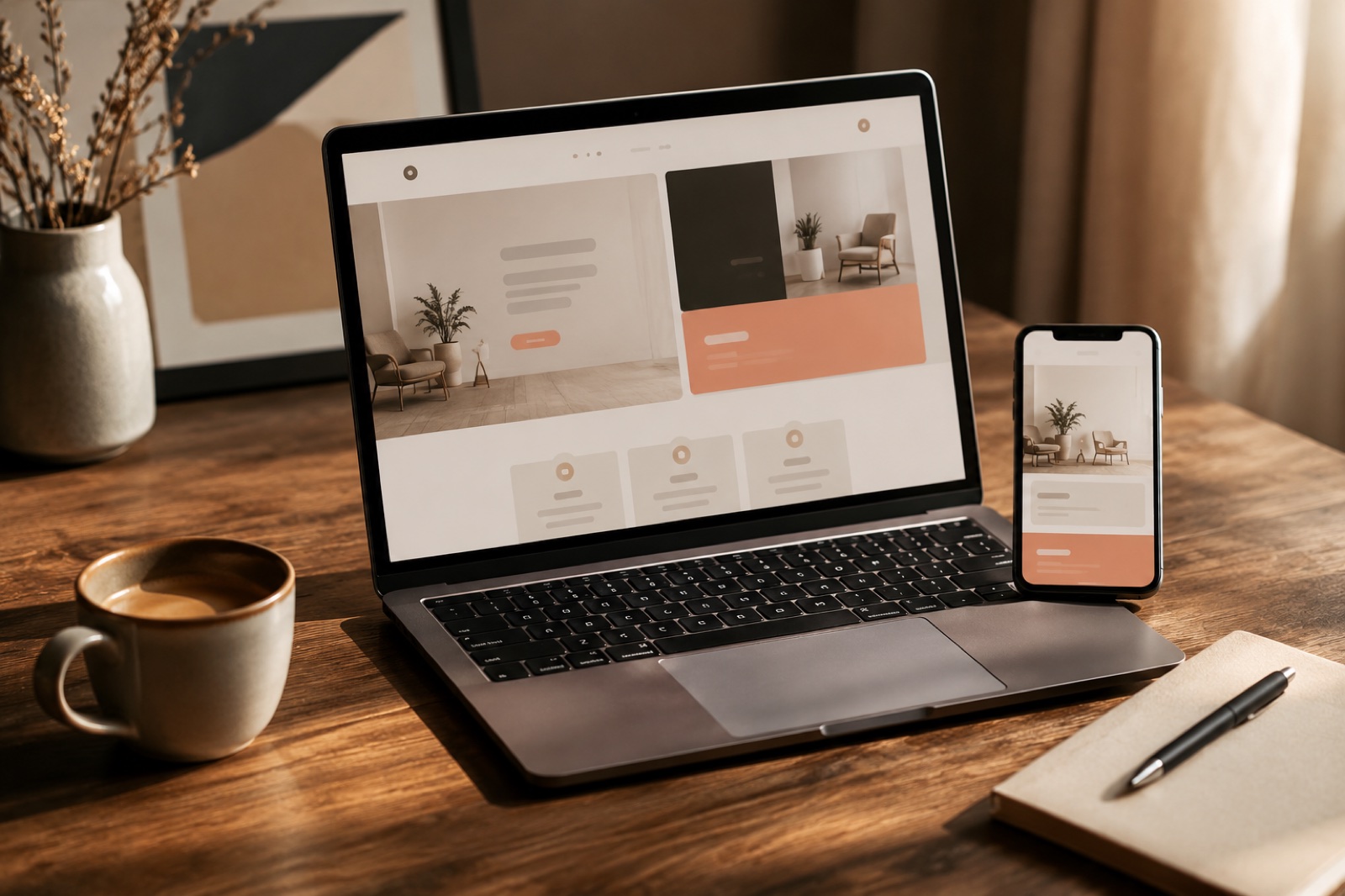
“We need an app.”
It’s one of the most common things business owners tell us — and most of the time, it isn’t what they actually need. Not because an app is a bad idea, but because “app” has quietly become shorthand for “I want my business to feel modern and serious online.” That feeling is the real goal. The technology is just one of several ways to get there — and often the most expensive one.
So before you spend on the wrong thing, let’s separate the three options in plain language, and work out which job you’re actually trying to do.
First, the three things — without the jargon
A website is your address on the internet. It’s where people land when they Google you, tap your Instagram link, or read your card. Its job is to make a strong first impression, build trust, and turn a curious visitor into an enquiry. Every business needs one. Full stop.
A web app is a website that does something — it doesn’t just inform, it lets people act. A booking system, a customer dashboard, an order tracker, a quote calculator, a members’ area. It runs in the browser, so there’s nothing to download. If your customers need to do a task with you, repeatedly, this is usually the answer.
A phone app is the icon that lives on someone’s home screen, installed from the App Store or Play Store. It can use the camera, send push notifications, work offline, reach into the phone’s hardware. It’s powerful — and it’s the heaviest, slowest and most expensive of the three to build and maintain. People also have to be convinced to install it, which is a real barrier.
The question almost everyone gets backwards
The instinct is to ask, “Which technology should we build?” The better question is, “What do we need our customer to do — and how often?”
- If they need to find you, trust you, and reach out → you need a website, done exceptionally well.
- If they need to transact or manage something with you, repeatedly → you need a web app.
- If they need it on their phone, every day, using its hardware or offline → only then does a phone app earn its cost.
Most businesses we meet need the first, sometimes the second, and rarely the third. Spending phone-app money to solve a website problem is the most common — and costly — mistake we see.
When clients say they want an “app experience,” they’re describing a feeling — not a tech stack.
An app is a feeling, not a technology
Here’s the part that saves a lot of money. When clients want something fast, smooth, premium and installable, they’re describing a feeling — and today you can deliver almost all of that feeling from the web.
A modern Progressive Web App can be added to a home screen, open full-screen with no browser bar, load instantly, and even work offline — without anyone visiting an app store. To your customer, it feels like an app. To you, it’s built and maintained at a fraction of the cost of a native one. For a large share of businesses, that’s the sweet spot: the app feeling, without the app price.
What it actually costs you — in time, not just money
The hidden cost of a phone app isn’t only the build. It’s the upkeep: two platforms (iOS and Android), app-store reviews, constant OS updates, and the marketing push to get people to install it in the first place. A website or web app updates instantly, for everyone, the moment you publish. Before you commit to an app, be honest about whether you have the appetite to feed it for years.
So — what should most businesses do?
Start with a website that genuinely works: fast on every phone, easy to find on Google, and designed to turn visitors into enquiries. If your business involves a repeated task your customers do with you, layer a web app on top. Reach for a PWA when you want that installable, app-like feel without the native cost. And build a true phone app only when the job genuinely lives on the phone — and you’re ready to invest in it for the long haul.
The goal was never “have an app.” The goal is to look world-class, win trust, and make it effortless for people to do business with you. Pick the lightest tool that gets you there.